


Some things never change. Or at least, that’s what I used to believe about Berliner Wine Trophy.
Since 2014, when I first took part, this competition has been, for me, the definition of consistency. Almost ritual-like, year after year, we would meet in the same place: the hotel at Borsigturm, near Lake Tegel, in a part of Berlin that felt almost provincial—quiet, calm, far removed from the city’s intensity. It was more than just a location. It was a familiar rhythm, a routine, a family. The family remained. But in 2026, for the first time, the setting changed.
The move to Alexanderplatz felt like a subtle disruption to a long-standing tradition. From a nearly contemplative area, we suddenly found ourselves in the heart of the city, within walking distance of Berlin’s major landmarks. A larger hotel, a more generous tasting space, more movement, more energy. We gathered again, but on that first evening we missed the instinct of familiar places. It took time to recalibrate, to find our rhythm again—including one of the most cherished rituals: sharing the wines we each bring from home, among colleagues, friends, and, ultimately, this extended family that defines the BWT jury. Then the four days of judging began.
This year again, I served as team leader for one of the panels—a role I’m well acquainted with, yet one that consistently demands precision and discipline. Beyond the logistics—verifying samples, aligning bottles with the system, ensuring each wine is assessed—the role requires a constant exercise in objectivity. At Berliner Wine Trophy, preference is irrelevant; only quality matters. A wine must be evaluated for what it is, not for whether it aligns with personal taste. Even when it doesn’t.

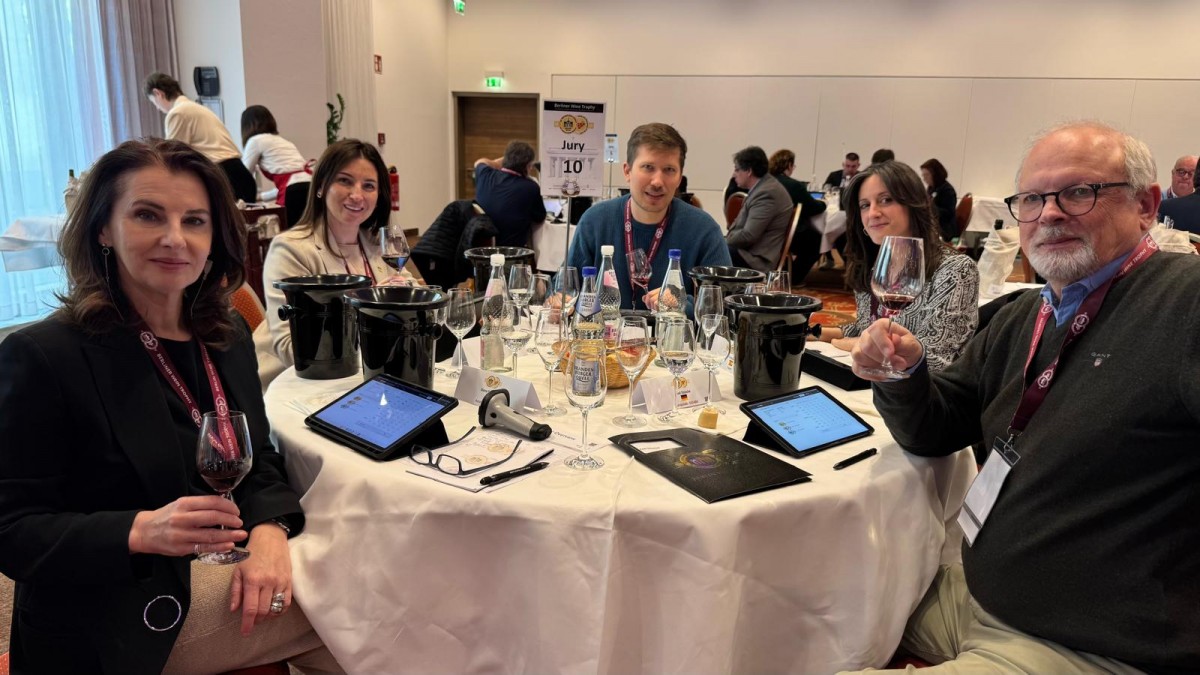
The overall quality this year made that easier. Faults were notably rare—arguably the lowest I’ve encountered across editions. Each day, around 50 wines guided us through a diverse European landscape and beyond, offering a shared, focused tasting experience within the panel.
Across the four days, several wines stood out at Grand Gold level—wines of precision, balance and clear regional identity. Among them: a German Spätburgunder, a refined Grauburgunder–Weissburgunder blend, a 2019 Champagne, two Argentine Malbecs (2023 and 2017), a Chilean Cabernet–Carmenère blend and a Portuguese Touriga Nacional from 2019. Notably, none were sweet or fortified—categories that often impress immediately. Instead, these were dry wines, defined by structure, complexity and a strong sense of origin.
A particularly compelling flight was formed by the Romanian wines—dry whites. Out of 17 samples, one was returned due to cork taint and replaced with a second bottle, which was ultimately assessed by another panel. The remaining wines performed with confidence: 3 Silver Medals, and all others Gold. Fetească varieties showed clarity, balance and expressive character, while a Tămâioasă Românească came remarkably close to Grand Gold level. Careful not to appear biased, I found that my fellow judges were, in fact, even more generous in their scoring—an encouraging signal that Romania’s indigenous varieties are gaining well-deserved recognition and should sit at the core of a coherent promotion strategy.
On a broader level, the 2024 vintage in Europe appears challenging. The impact of climate change is increasingly visible: wines remain correct and typologically accurate, yet occasionally with a more restrained aromatic profile. In contrast, early impressions from 2025 suggest greater freshness and accessibility. Another notable shift: fewer rosé wines than in previous years—perhaps a sign of a softening trend—alongside a strong presence of Pinot Noir in multiple expressions. The direction seems clear: a growing preference for lighter, fruit-driven reds, with minimal oak influence.
Beyond the competition itself, the experience was enhanced by something simple: the weather. Warm temperatures allowed us to begin with a beer on a terrace just next to the hotel—one of the small but meaningful advantages of the new location. And the real surprise came on a Tuesday evening, when, without expectations, we discovered live music and found ourselves in one of the most memorable moments of this edition.
Because, in the end, Berliner Wine Trophy is not just about wine. It is about people, encounters, shared experiences—and that rare sense that, wherever it moves, the family remains the same. And sometimes, change simply confirms it.








Social Icons